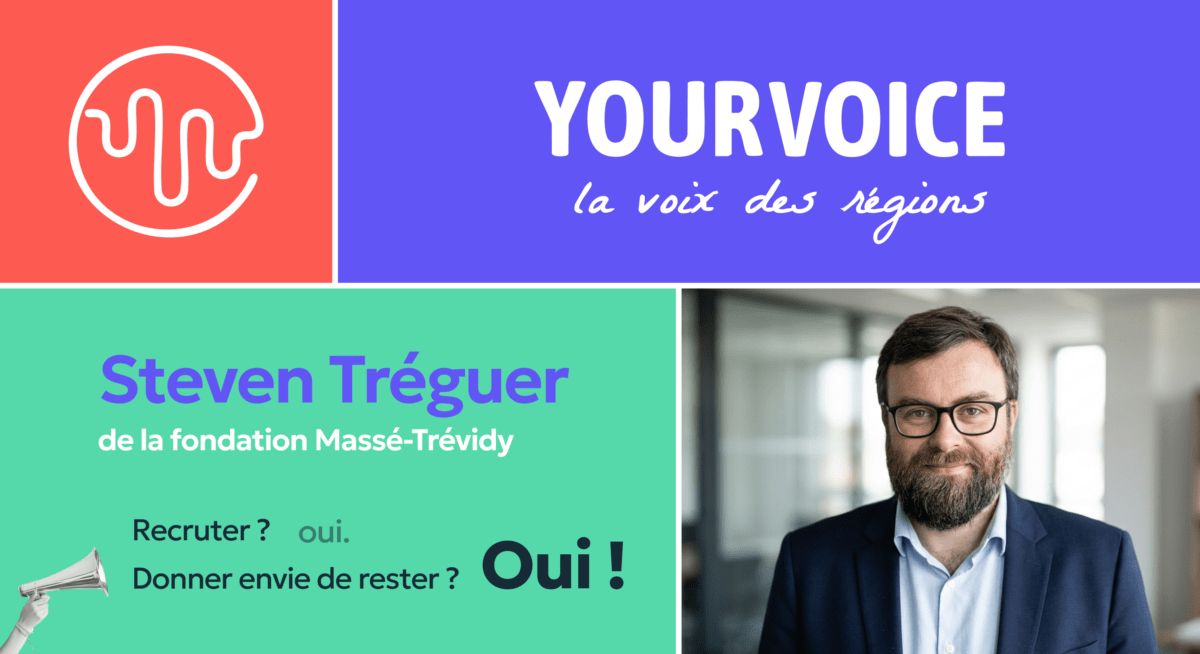
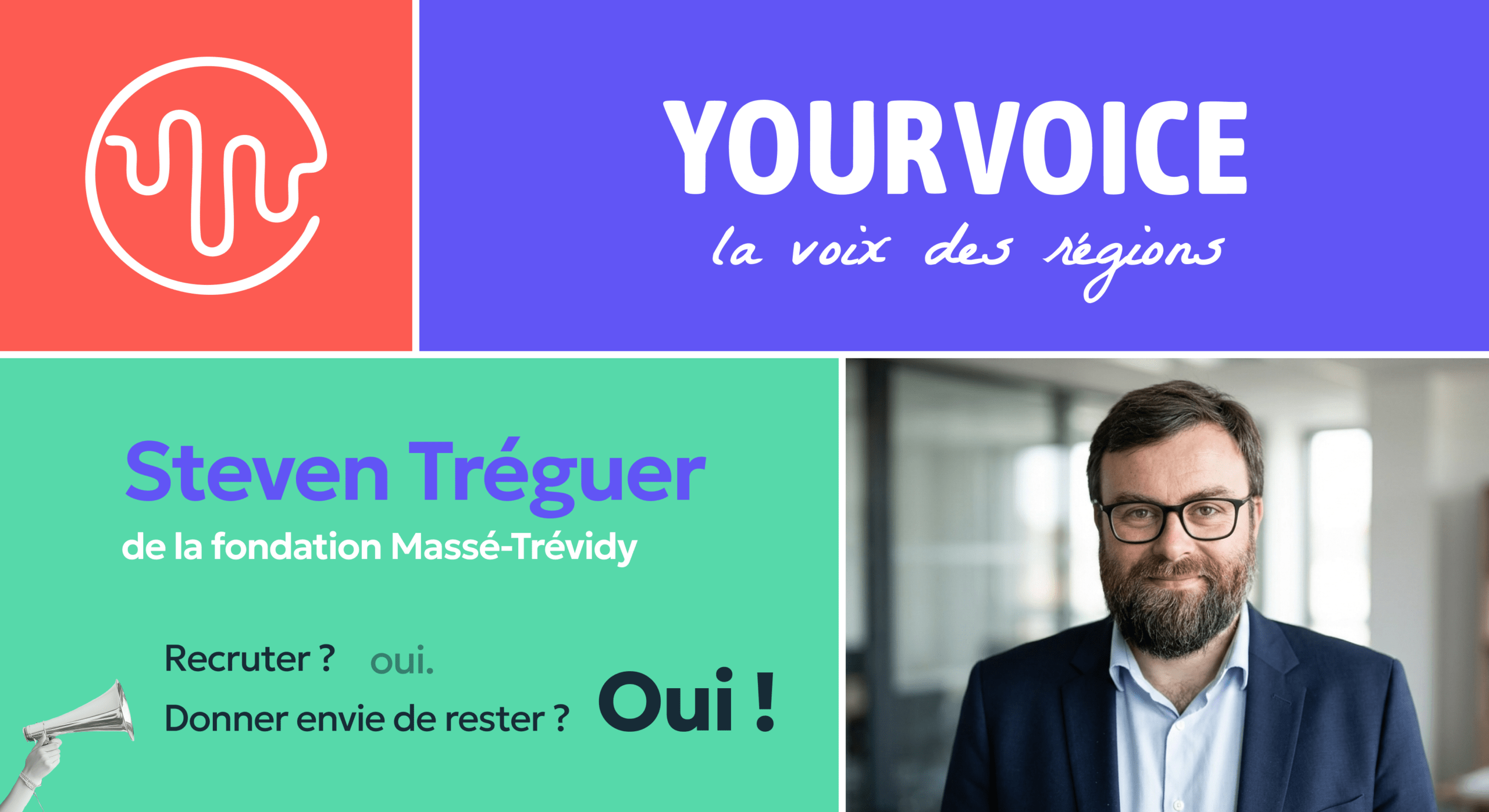
As head of the Massé-Trévidy Foundation in Brittany, Steven Tréguer takes a clear stance: in the social and medical-social sectors, attractiveness isn’t just about job postings or employer branding. It comes down to trust, compensation, and empowering teams to truly make a difference on the ground.
An interview with an executive who speaks candidly about employment.
He has the precise way of speaking typical of those with a legal background, an appreciation for institutions, but also a very down-to-earth way of talking about work, teams, professions facing labor shortages, and wages that no longer keep pace. Steven Tréguer, Executive Director of the Massé-Trévidy Foundation, doesn’t mince words. When he talks about recruitment, he starts with the front lines. When he talks about attractiveness, he talks first about compensation. And when he talks about management, he always comes back to the same idea: trust.
Before we talk about your job, let’s talk about you. How did you end up as the executive director of a major foundation in Brittany?
My career path hasn’t been entirely linear, but it has a certain coherence. I trained as a lawyer, specializing in public law, and have long been interested in institutions. What interested me was how an organization serves a collective mission. I started in the French National Education System as a middle school administrator after graduating from the Regional Institute of Administration in Nantes. I chose to work in a priority education zone. Back then, we called them ZEPs; today, we’d call them REPs.
And that’s when I discovered child welfare. Not in theory, but in practice—through the children’s life stories, their family situations, and everything that happens around the school. That’s what made me change course. I decided I wanted to be more directly involved in these efforts.
So you're leaving the Department of Education?
Yes. I’m taking the EHESP exam to become a director of a health, social, and medical-social facility. I didn’t want to be a hospital director. What really interested me was child welfare. I then headed the Essonne Departmental Institute for Children and Families in Brétigny-sur-Orge, in a very demanding, high-pressure environment, dealing with emergency intake, situations of extreme distress, and sometimes extreme violence.
It’s a world where things make sense right away. You don’t wake up in the morning wondering why you’re going to work. You just know. It’s tough, but you know it.
And after the emergency, what about senior management?
Yes, but not right away. I always thought I wouldn’t stay too long in such a high-profile role in emergency child protection. You have to know when to pass the baton at the right moment. I then applied for executive positions at foundations and nonprofit organizations. I was young and came from the public sector, which, paradoxically, could be seen as a double disadvantage in the private nonprofit sector. And then I was hired by the Fondation Jeunesse Feu Vert in the Île-de-France region.
Then came Massé-Trévidy. What interested me there was the diversity of the project, the wide range of activities, and its ability to address various areas of social solidarity. And there was already a genuine—though not yet fully realized—intention to empower local communities through subsidiarity. That was something that immediately resonated with me.
You talk a lot about trust. Is that the backbone of your management style?
Yes, definitely. I believe in subsidiarity. We believe in the genuine delegation of responsibilities—not just a superficial one.
At Massé-Trévidy, what sets us apart is our ability to give the field the freedom to take the lead. This means that managers are truly in charge of their areas of responsibility, their hiring, their negotiations, and their projects. They are accountable, of course, but they are not there simply to carry out decisions made entirely at the top.
In many organizations, especially when financial conditions become strained, there is a tendency to centralize again. We tighten the reins, we lock things down, we take back control. I think that’s a mistake. Even in difficult times, we must maintain this approach of local accountability; otherwise, we stifle the organization. This also reflects a lived societal reality, with all its consequences, which are by no means minor.
When we talk about employment in Brittany today, what do you see from your vantage point?
First of all, we need to be cautious. There is no single, uniform market in Brittany. Conditions vary greatly depending on the profession, region, and sector. But in our field, the situation is quite clear.
The first is the severe strain on frontline care and support roles: nursing assistants, nurses, certain staff members, as well as technical roles such as cooks and maintenance workers. We’re facing a real shortage here, particularly in certain areas along the southern coast of Finistère.
On the other hand, when it comes to education-related roles, we are not currently facing any major recruitment challenges. The same is true, generally speaking, for management positions. There may be exceptions—more niche roles or situations where the balance is more fragile—but the situation is entirely different. We have 40 different roles, and the balance varies from one to another.
Ultimately, the issue isn't just about attracting candidates, but about being able to hire them under reasonable terms.
Yes, because that's the truth. The real obstacle in many fields isn't sourcing. It's the pay level.
We can always try to improve communication, channels, and tools, but at some point we have to face the facts. When someone is comparing different jobs, the first thing they do is see if they can make ends meet on the salary. That’s the bottom line.
And in our industry, in certain fields, we’re not up to par. We know that. There are even working poor. That’s not just a cliché. It’s a reality. So if we want to be attractive, we also have to be willing to talk about money.
You put it quite bluntly. That’s not always the case in this industry.
Because we sometimes tend to make symbolic compromises. We talk about meaning, commitment, and the collective good, and all of that matters a great deal. But it doesn’t pay for gas, it doesn’t pay the rent, and it doesn’t provide for a family’s stability.
In jobs that don’t necessarily require extensive training, we’re in direct competition with other sectors—such as the restaurant industry, the food processing sector, and sometimes retail. And in those cases, the decision comes down to very practical factors like starting pay, work hours, and work-life balance.
Brittany, and Finistère in particular, also has a reputation for being a region that’s very close-knit. Does that affect recruitment?
Yes, of course. Finistère has a strong identity. People from Finistère travel, but they also love their home region. For executive positions, we can attract candidates from outside the department, or even outside the region, especially when they have a life plan or are returning to Brittany. But for frontline roles, mobility is much more limited.
In practice, we’re looking at a radius of 20 to 25 kilometers, sometimes 50 if the project is really worth it. Beyond that, the cost of travel becomes prohibitive relative to wages. And even within Finistère itself, there are strong regional dynamics at play. Between Brest and Quimper, for example, there isn’t a clear, natural flow of traffic.
From what you’re saying, it seems that appeal isn’t just about “the outside,” but also very much about “the inside.”
Absolutely. Attractiveness isn’t just about bringing people in. It’s also about keeping them here. And to keep them here, you need a comprehensive, consistent approach.
We are working on compensation, with above-market pay for certain roles. The idea is to set more attractive minimum thresholds and better recognize experience. If the national framework doesn’t evolve quickly enough, employers will have to take the lead.
But that’s not all. There’s also how work is organized, opportunities for discussion, support for managers, and how we carry out a team project.
Specifically, what have you implemented in Massé-Trévidy?
We’ve developed several initiatives. First, co-development spaces for senior executives. The idea is to move away from the traditional one-on-one meeting with a superior and allow everyone to bring a topic to the table and work on it with their peers in a safe environment.
We have also expanded our analysis of practices, including in nursing homes. This is fundamental to our work. And recently, we held a three-year review of the foundation project with all senior managers. This was almost unprecedented for us. It allowed us to share insights, build mutual understanding, and strengthen our sense of community.
These aren't just HR gimmicks. They are tools for building employee loyalty and fostering sound managerial thinking.
Is your “employer brand,” at its core, really that culture?
For executives, yes, definitely. It’s not a brand in the marketing sense. It’s a work culture.
The executives who join us know they’ll have autonomy, responsibility, and the ability to truly lead projects. We see this in the applications: some come from the public sector, others from the nonprofit sector, and still others from the private sector. They come because they’re looking for a more coherent, less stressful environment that’s better aligned with what they want to do.
And yet, you also say that not everything is perfect.
Of course. We need to keep a clear head. For example, we have a reputation issue on certain online platforms. Former employees may post negative comments on review sites, and this affects the overall perception of the Foundation. It doesn’t necessarily reflect the reality on the ground, but it’s a reputational issue that needs to be addressed.
We also need to do a better job of communicating what we do. Many organizations in the sector are doing excellent work, but they don’t communicate it effectively. And these days, if you don’t tell your story, others will tell it for you.
You have this saying: “The real issue isn’t just about hiring; it’s about making people want to stay.” Is that your firm belief?
Yes, absolutely. Hiring is important. But if you hire people only to lose them later, you haven’t solved anything. The real issue is retention.
And employee retention isn’t just about a bonus or a marketing campaign. It depends on a combination of factors: purpose, compensation, the quality of leadership, autonomy, recognition, work organization, and the opportunity to have a clear role within a team.
People stay when they feel that they are making a difference, that they are respected, that they have the freedom to act, and that they are not trapped in a system that wears them down.
One last question. If you had to speak to a young person—or someone a bit older—who is hesitant about entering the health, social services, or medical-social sector, what would you say to them?
I would tell them: Come join us in our community service activities.
Because, deep down, that’s what it comes down to. This sector still offers something rare: the chance to play an individual role within a meaningful collective. It provides a sense of purpose, a sense of connection, and a very concrete form of social necessity.
Of course, this requires decent working conditions. I’m not saying that a sense of purpose is enough. But even so, I believe these professions offer an experience you don’t find everywhere: the experience of being connected to something greater than oneself, without being lost in the collective.
And these days, that’s no small thing.
The Massé-Trévidy Foundation, a major player in community outreach in Brittany
A long-standing leader in the health, social, and medical-social sectors in Brittany, the Massé-Trévidy Foundation supports thousands of people each year through a wide range of services, including child welfare, employment assistance, disability services, care for the elderly, and home care.
Based primarily in Finistère, the foundation employs nearly 1,100 people and is active in some 15 public policy areas, with an organizational structure centered on regions and autonomous divisions.
What sets it apart is its commitment to a model of subsidiarity and local accountability, which grants field teams a high degree of autonomy in project implementation, management, and operational decision-making.
For several years now, the Foundation has also been developing innovative forms of cooperation, notably by becoming an umbrella foundation, which allows it to host and support other initiatives without merging with or absorbing them.
With its strong local roots and commitment to adapting to changes in the sector, Massé-Trévidy positions itself as a key player in the transformation of social solidarity, facing—like the sector as a whole—the challenges of attracting talent, securing funding, and renewing business models
Keep up to date with all YourVoice media news!